What to Expect When No One's Expecting How to Make Babies
What to Look When No One'southward Expecting
Last updated  Get-go edition | |
| Author | Jonathan V. Last |
|---|---|
| Genre | Non-fiction |
| Published | 2013 |
| Publisher | Encounter Books |
| ISBN | 978-1594037313 |
What to Expect When No One'south Expecting: America's Coming Demographic Disaster is a book past the Weekly Standard columnist Jonathan V. Terminal about declining birthrates in the Us and elsewhere around the world and the implications for demographics and the functioning of society and the economy (hardcover release February 2013, paperback release June 2014). [1]
- Reception
- Media appearances, interviews, and self-promotion
- Detailed reviews
- Mentions
- See also
- References
Reception
Media appearances, interviews, and self-promotion
Last wrote an commodity in the Wall Street Periodical summarizing the key themes of his book. [ii]
Last was interviewed by Kathryn Jean Lopez for National Review . [3] He also appeared to discuss the book on John Stossel's show on the Trick Concern Network [4] and on MSNBC's programme The Wheel. [five]
Detailed reviews
Nick Gillespie, editor of Reason Magazine , reviewed the volume on Bookforum, maxim that he was convinced by Last'south statement that birthrates were failing and there was not much that could be done about information technology, but found Last'southward business relationship of the negative consequences exaggerated. [6] [7]
David Desrosiers reviewed the book favorably for Washington Times , writing that Concluding has argued that declining birthrates are largely a consequence of the changes prepare in movement by the Enlightenment rather than of whatsoever specific regime policies, though policies past US liberals may take sped up the decline. [8] Stanley Kurtz and Bradford Wilcox wrote separate reviews of the book for National Review . [nine]
William McGurn, editor of the New York Post , reviewed the volume favorably for the Wall Street Journal , just was disquisitional of Concluding for having too much confidence in his pessimistic scenarios. McGurn concluded: "In theory, it's all certainly possible. But as Mr. Last reminds us, nosotros practise well to be small about our predictions. Considering the one thing the math tells us is this: We've never been hither before." [10]
Walter Russell Mead reviewed the book for Foreign Affairs . [11]
Joel E. Cohen reviewed the book for The New York Review of Books . [12]
Mentions
Elizabeth Kolbert discussed the book forth with many others in an commodity for The New Yorker near population. [13] Last wrote a response to Kolbert's review, [fourteen] and Daniel Halper concurred with Final's assessment of the review, challenge that Kolbert "gets it completely wrong." [15]
A New York Times commodity in April 2013 listed Final's book as one of many that was raising a "false alarm" about declining The states fertility. [16]
Run into also
- The Empty Cradle by Phillip Longman
Related Research Articles
In demography, demographic transition is a phenomenon and theory which refers to the historical shift from loftier birth rates and high infant death rates in societies with minimal applied science, education and economic development, to low birth rates and low expiry rates in societies with advanced technology, education and economic development, every bit well as the stages between these two scenarios. Although this shift has occurred in many industrialized countries, the theory and model are frequently imprecise when applied to individual countries due to specific social, political and economic factors affecting item populations.
A baby boom is a period marked by a significant increase of birth rate. This demographic phenomenon is commonly ascribed within certain geographical bounds of defined national and cultural populations. People born during these periods are often called babe boomers. The cause of infant booms involves diverse fertility factors. The best-known infant boom occurred in the mid-twentieth century, sometimes considered to have started afterward the finish of the Second World State of war, sometimes from the late 1930s, and ending in the 1960s.
Fertility is the quality of being able to produce offspring through reproduction following the onset of sexual maturity. As a measure out, the fertility rate is the boilerplate number of children that a female has in her lifetime and is quantified demographically. Fertility is most commonly considered when there is a difficulty or an inability to reproduce naturally, and this is also referred to as infertility. Experiencing infertility is non discriminatory against any particular individual and the phenomenon is widely acknowledged, with fertility specialists available all over the globe to provide expertise for assisting mothers and couples who experience difficulties having a baby.

The birth rate in a period is the full number of live births per ane,000 population divided by the length of the period in years. The number of live births is normally taken from a universal registration system for births; population counts from a demography, and estimation through specialized demographic techniques. The nascence rate is used to calculate population growth. The estimated boilerplate population may be taken as the mid-year population.
Zippo population growth, sometimes abbreviated ZPG, is a condition of demographic balance where the number of people in a specified population neither grows nor declines, considered as a social aim by some. This is related to the optimum population theory, where a certain population is the platonic towards which countries and the whole world should aspire in the interests of accomplishing long-term environmental sustainability. What it means by 'the number of people neither grows nor declines' is that births plus in-migrants equal deaths plus out-migrants.

Sub-replacement fertility is a full fertility rate (TFR) that leads to each new generation being less populous than the older, previous one in a given area. The Un Population Sectionalization defines sub-replacement fertility as whatever rate below approximately 2.i children born per woman of childbearing age, but the threshold tin can be as high as 3.4 in some developing countries considering of higher mortality rates. Taken globally, the full fertility charge per unit at replacement was 2.33 children per woman in 2003. This can be "translated" equally 2 children per woman to supervene upon the parents, plus a "third of a child" to make upwards for the college probability of males born and mortality prior to the terminate of a person'southward fertile life. In 2020, the average global fertility charge per unit was around 2.4 children born per woman.
Natalism is a belief that promotes the reproduction of human life. The term comes from the Latin adjective for "nativity", nātālis.
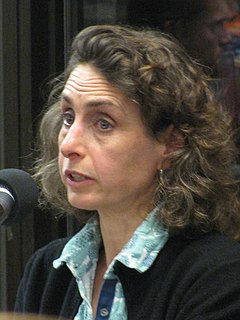
Elizabeth Kolbert is an American journalist, author, and visiting young man at Williams College. She is all-time known for her Pulitzer Prize-winning book The Sixth Extinction: An Unnatural History, and equally an observer and commentator on environmentalism for The New Yorker magazine. Like The Sixth Extinction, her writing and other books, such every bit Field Notes from a Ending and Under a White Sky frequently explore the crisis faced by humans in the Anthropocene.

Phillip Longman is a conservative American demographer. Soon he is a Schwartz Senior Fellow at the New America Foundation, and he formerly worked as a senior writer and deputy assistant managing editor at U.S. News & World Report.

The centre of the 20th century was marked by a significant and persistent increase in fertility rates in many countries of the world, especially in the West. The term baby boom is often used to refer to this particular boom, generally considered to accept started immediately after World War II, although some demographers place information technology before or during the war. This terminology led to those built-in during this infant boom being nicknamed the baby boomer generation.

Michael Due south. Teitelbaum is a demographer and the onetime Vice President of the Alfred P. Sloan Foundation in New York Urban center. He is Senior Research Associate at the Labor and Worklife Program, Harvard Law Schoolhouse.

The ageing of Europe, too known as the greying of Europe, is a demographic phenomenon in Europe characterised by a decrease in fertility, a decrease in bloodshed rate, and a higher life expectancy among European populations. Depression birth rates and higher life expectancy contribute to the transformation of Europe'south population pyramid shape. The almost meaning change is the transition towards a much older population structure, resulting in a decrease in the proportion of the working age while the number of the retired population increases. The total number of the older population is projected to increment greatly within the coming decades, with rise proportions of the post-state of war infant-boom generations reaching retirement. This volition cause a high burden on the working historic period population as they provide for the increasing number of the older population.
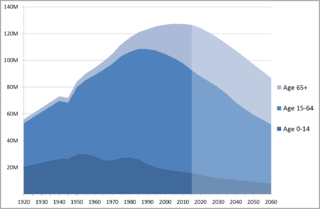
Japan has the highest proportion of elderly citizens of any country in the world. The land is experiencing a "super-aging" club both in rural and urban areas. According to 2014 estimates, 38.0% of the Japanese population is higher up the historic period of 60, 25.9% are aged 65 or above, and 12.v% are aged 75 or above. People anile 65 and older in Japan brand up a quarter of its total population, estimated to reach a third by 2050.

How Civilizations Dice is a volume written by the author and economist David P. Goldman, published on September 19, 2011 past Regnery Publishing. It discusses the declining in birthrates of both Europe and Islamic nations. In his view the reject in birthrates leads to the passive attitude of Europe, and the aggressive and violent attitude of the Islamic world, not from a stand up of power, merely from a signal of desperate action. Nearly of the book is based on articles he published under the pseudonym "Spengler" on the Asia Times newspaper.

The Sixth Extinction: An Unnatural History is a 2014 non-fiction book written by Elizabeth Kolbert and published by Henry Holt and Company. The book argues that the Earth is in the midst of a modernistic, man-made, sixth extinction. In the volume, Kolbert chronicles previous mass extinction events, and compares them to the accelerated, widespread extinctions during our nowadays fourth dimension. She also describes specific species extinguished by humans, besides as the ecologies surrounding prehistoric and near-nowadays extinction events. The writer received the Pulitzer Prize for General Non-Fiction for the book in 2015.
The Empty Cradle: How Falling Birthrates Threaten World Prosperity is a 2004 volume by Phillip Longman of the New America Foundation nearly declining birthrates around the world, the challenges that Longman believes volition back-trail it, and strategies to overcome those challenges.
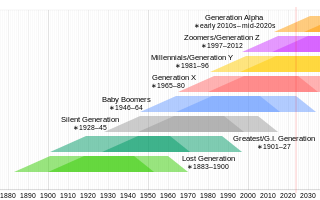
Generation Alpha is the demographic cohort succeeding Generation Z. Researchers and pop media use the early 2010s as starting birth years and the mid-2020s as catastrophe nascency years. Named after the first letter in the Greek alphabet, Generation Alpha is the start to exist built-in entirely in the 21st century. Nigh members of Generation Blastoff are the children of Millennials.
The low nascency rate in Southward Korea demonstrates the intersection of the low fertility rate in Republic of korea and government policies. Republic of korea's nascency charge per unit has declined since 1960. Until the 1980s, it was widely believed that this demographic trend would end and that the population would somewhen stabilize. However, Korean society faces a decline in its futurity population because of the continuously decreasing nascency rate. After the baby boom in the 1950s, the population increased drastically, and the Korean authorities implemented an anti-natalistic policy in the 1960s. This government programme mandated that Korean healthcare centers provide a family planning consultation by introducing traditional contraception methods, including intrauterine devices (IUDs), vasectomies, and condoms to the public. Along with this policy and economic growth, the fertility rate declined because more married women pursued wealth and a college standard of living rather than raising children. Subsequently the economic crisis in 1997, the fertility rate declined rapidly.
The Fixed Future is a book published in 2016, written by Cho Young-tae. This volume is not translated into English. The book introduces Korea'due south time to come from a demographic perspective. The author says the future of Korea is somewhat set up and predictable. From a demographic perspective, South Korea's hereafter is not positive, simply the futurity of individuals is not gear up. It may vary depending on what choices an individual makes in the stock-still future. Books provide insight to assist with that choice.
The United States nativity rate has gone downward naturally throughout the country'southward history. This trend has led some demographers to speculate that the United States could end up with an aging and shrinking population and workforce, especially considering many developed countries effectually the globe have already been impacted from this trend. Other demographers have argued that population aging in the U.s.a. could be solved with policy reforms, or that it could have a positive impact on the country.
References
- ↑ Last, Jonathan. What to Await When No Ane'south Expecting: America's Coming Demographic Disaster. See Books. ISBN 978-1594037313.
- ↑ Last, Jonathan V. (February 12, 2013). "America's Baby Bust: The nation's falling fertility rate is the root cause of many of our issues. And it's just getting worse". Wall Street Journal . Retrieved February 18, 2014.
- ↑ Lopez, Kathryn Jean (February 21, 2013). "Disaster Coming? The dark clouds of demography". National Review . Retrieved February 18, 2014.
- ↑ Stossel, John. "Why Fewer Babies Could Hurt the Economic system". Fox Business concern Network.
- ↑ "Jonathan Last Discusses America's Baby Bust". Washington Free Beacon. Feb 28, 2013. Retrieved February eighteen, 2014.
- ↑ Gillespie, Nick (April–May 2013). "Let It Breed: A conservative author finds economical peril in population reject" . Retrieved February eighteen, 2014.
- ↑ Gillespie, Nick (March 28, 2013). "Nick Gillespie on What to Wait When No One's Expecting: America's Coming Demographic Disaster". Reason Magazine (Striking and Run web log). Retrieved Feb 18, 2014.
- ↑ DesRosiers, David (March 4, 2013). "BOOK REVIEW: 'What to Expect When No I'southward Expecting'". Washington Times . Retrieved February 18, 2014.
- ↑ Kurtz, Stanley (Feb v, 2013). "Jonathan Last's What to Expect When No One'south Expecting" . Retrieved February 18, 2014.
- ↑ McGurn, William (February 20, 2013). "The Children Of Men: For decades we've been warned most the dangers of overpopulation. The real threat to our future, argues Jonathan V. Last, is that we are non having enough babies" . Retrieved Feb eighteen, 2014.
- ↑ Mead, Walter Russell (May–June 2013). "What to Look When No One'south Expecting: America's Coming Demographic Disaster Past Jonathan V. Terminal". Foreign Affairs . Retrieved February 18, 2014.
- ↑ The Case for More Babies Apr 24, 2014 issue of The New York Review of Books
- ↑ Kolbert, Elizabeth (October 21, 2013). "Head Count: Fertilizer, fertility, and the clashes over population growth". The New Yorker . Retrieved Feb eighteen, 2014.
- ↑ Terminal, Jonathan V. (October xvi, 2013). "The New Yorker and 'What to Wait'" . Retrieved Feb xviii, 2014.
- ↑ Halper, Daniel (October sixteen, 2014). "New Yorker Botches 'What to Expect'". Weekly Standard . Retrieved February 18, 2014.
- ↑ Hoff, Derek S. (April 17, 2013). "The False Alarm Over U.S. Fertility". New York Times . Retrieved Feb xviii, 2014.
This page is based on this Wikipedia article
Text is available under the CC BY-SA iv.0 license; additional terms may employ.
Images, videos and audio are available under their respective licenses.
What to Expect When No One's Expecting How to Make Babies
Source: https://WikiMili.com/en/What_to_Expect_When_No_One%27s_Expecting
0 Response to "What to Expect When No One's Expecting How to Make Babies"
Post a Comment