3 Span Continuous Beam Point Load
Calculating bending moments and shear forces in beams – in this case 3 span continuous beams – for different loading scenarios, is probably one of the things in structural engineering that we do throughout our studies and also careers later on.
After having covered the moment and shear formulas for simply supported and cantilever beams, in this article, we'll show, the most important and easiest formulas for continuous beams due to different loading scenarios like UDL line loads and point loads.
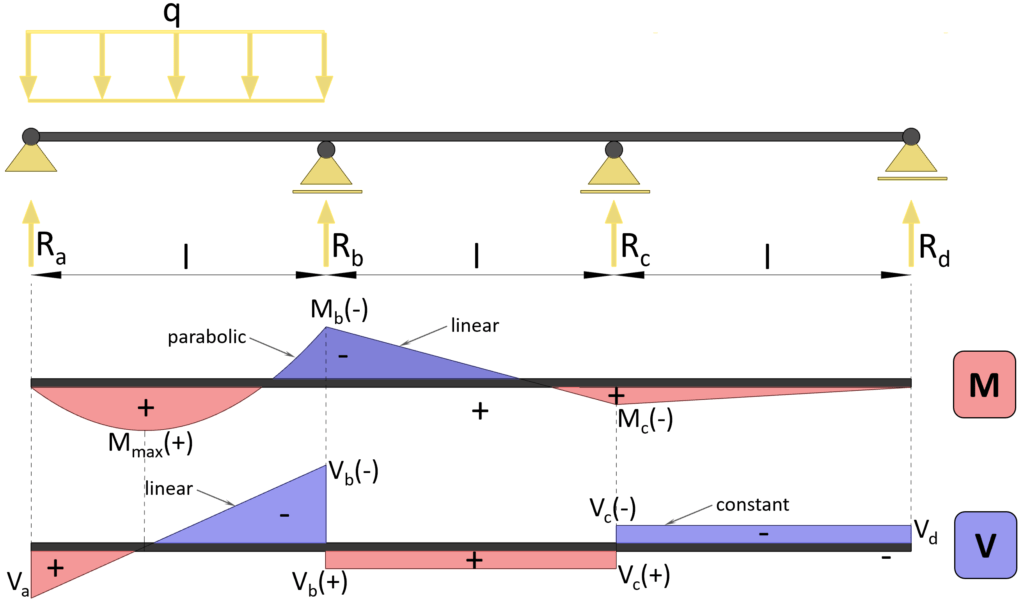
The formulas will be supported by images showing the moment and shear force diagrams.
Now, before we get started, always remember that the unit of the bending moment is Kilonewton meter [$kNm$] and Kilonewton [$kN$] for the shear forces when in Europe.
But now, let's get started.
1. Uniformly distributed line load (UDL) – 3 Span continuous beam
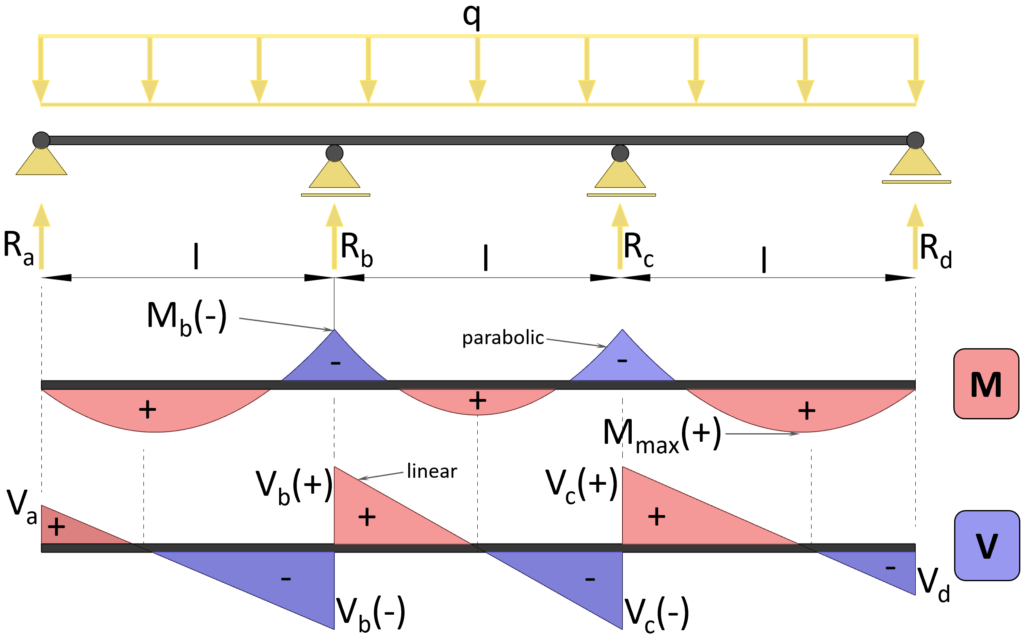
Max positive bending moment ($x=0.4 \cdot l$)
$M_{max} = 0.08 \cdot q \cdot l^2$
Max negative bending moment (at support b & c)
$M_{b} = -0.1 \cdot q \cdot l^2$
Shear force (at support a & d)
$V_{a} = 0.4 \cdot q \cdot l$
Shear force (at support b & c)
$V_{b(-)} = -V_{c(+)} = -0.6 \cdot q \cdot l$
$V_{b(+)} = -V_{c(-)} = 0.5 \cdot q \cdot l$
Reaction force support a & d
$R_a = R_d = 0.4 \cdot q \cdot l$
Reaction force support b & c
$R_b = R_c = 1.1 \cdot q \cdot l$
2. Uniformly distributed load (UDL) on 2 neighbouring spans – 3 Span continuous beam
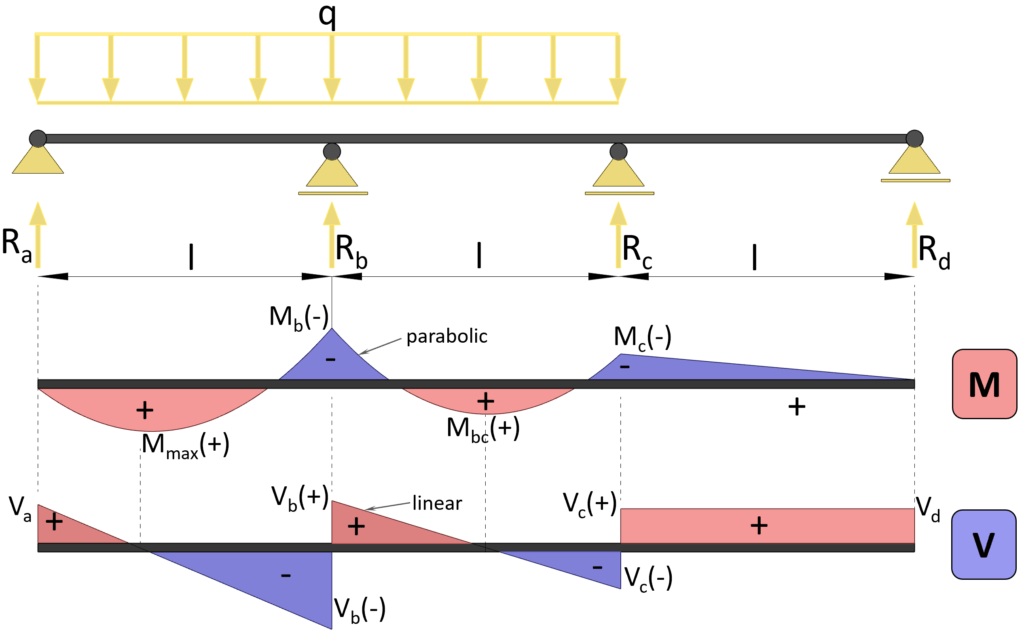
Max positive bending moment
$M_{max} = 0.0735 \cdot q \cdot l^2$
Positive bending moment $M_{bc}$
$M_{bc} = 0.0534 \cdot q \cdot l^2$
Max negative bending moment (at support b)
$M_{b} = -0.117 \cdot q \cdot l^2$
Negative bending moment (at support c)
$M_{c} = -0.033 \cdot q \cdot l^2$
Shear force (at support a)
$V_{a} = 0.383 \cdot q \cdot l$
Shear force (at support b)
$V_{b(-)} = -0.617 \cdot q \cdot l$
$V_{b(+)} = 0.583 \cdot q \cdot l$
Shear force (at support c)
$V_{c(-)} = -0.417 \cdot q \cdot l$
$V_{c(+)} = 0.033 \cdot q \cdot l$
Shear force (at support d)
$V_{d} = 0.033 \cdot q \cdot l$
Reaction force support a
$R_a = 0.383 \cdot q \cdot l$
Reaction force support b
$R_b = 1.2 \cdot q \cdot l$
Reaction force support c
$R_c = 0.45 \cdot q \cdot l$
Reaction force support d
$R_d = -0.033 \cdot q \cdot l$
3. Uniformly distributed line load (UDL) on 2 outer spans – 3 Span continuous beam
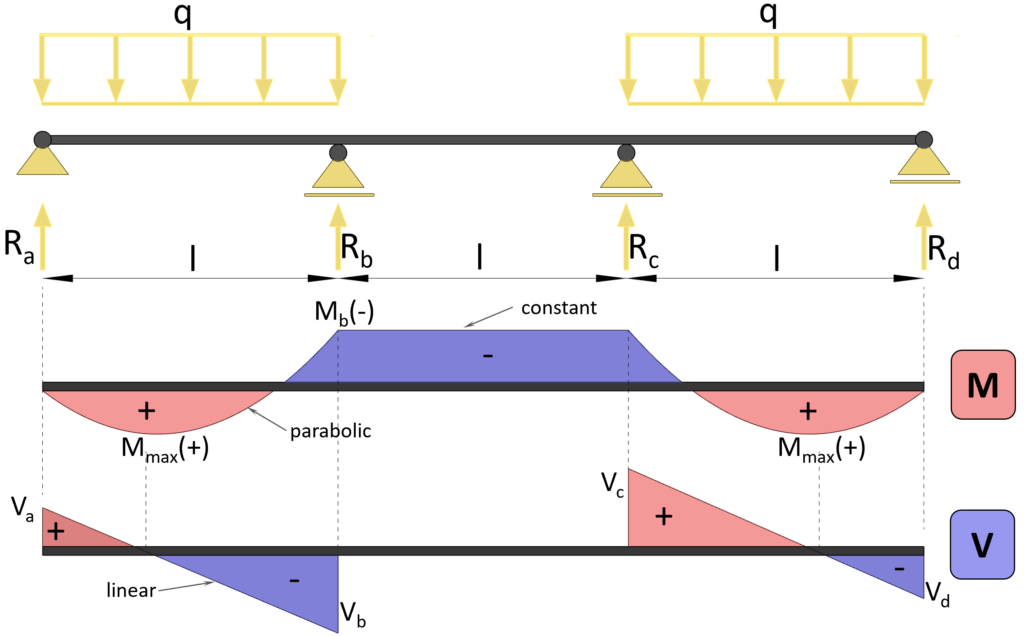
Max positive bending moment
$M_{max} = 0.101 \cdot q \cdot l^2$
Max negative bending moment (support b – c)
$M_{b} = -0.05 \cdot q \cdot l^2$
Shear force (at support a & d)
$V_{a} = (-)0.45 \cdot q \cdot l$
Shear force (at support b)
$V_{b} = -0.55 \cdot q \cdot l$
Shear force (at support c)
$V_{c} = 0.55 \cdot q \cdot l$
Reaction force support a & d
$R_a = R_d = 0.45 \cdot q \cdot l$
Reaction force support b & c
$R_b = R_c = 0.55 \cdot q \cdot l$
4. Uniformly distributed line load (UDL) on middle span – 3 Span continuous beam
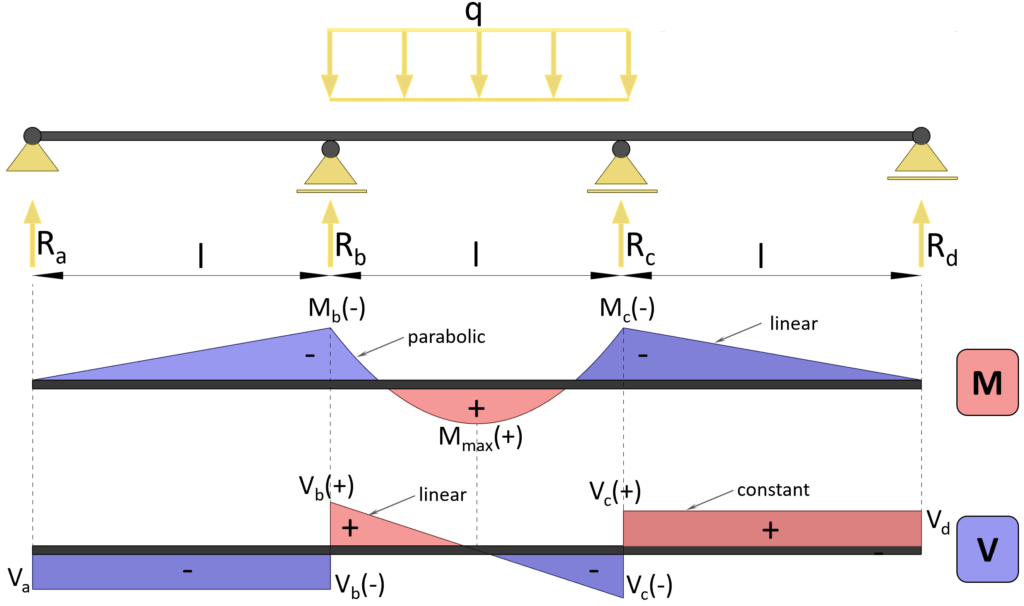
Max positive bending moment
$M_{max} = 0.075 \cdot q \cdot l^2$
Max negative bending moment (support b & c)
$M_{b} = -0.05 \cdot q \cdot l^2$
Shear force (at support a & d)
$V_{a} = V_{d} =(-)0.05 \cdot q \cdot l$
Shear force (at support b)
$V_{b(+)} = 0.5 \cdot q \cdot l$
Shear force (at support c)
$V_{c(-)} = -0.5 \cdot q \cdot l$
Reaction force support a & d
$R_a = R_d = -0.05 \cdot q \cdot l$
Reaction force support b & c
$R_b = R_c = 0.55 \cdot q \cdot l$
5. Uniformly distributed line load (UDL) on outer span – 3 Span continuous beam
Max positive bending moment
$M_{max} = 0.094 \cdot q \cdot l^2$
Max negative bending moment (support b)
$M_{b} = -0.067 \cdot q \cdot l^2$
Positive bending moment (support c)
$M_{c} = 0.017 \cdot q \cdot l^2$
Reaction force support a
$R_a = 0.433 \cdot q \cdot l$
Reaction force support b
$R_b = 0.65 \cdot q \cdot l$
Reaction force support c
$R_c = -0.1 \cdot q \cdot l$
Reaction force support d
$R_d = 0.017 \cdot q \cdot l$
If you are new to structural design, then check out our design tutorials where you can learn how to use the calculated bending moments and shear forces to design structural elements such as
- Design of timber roof beams
- Buckling design of timber columns
- Buckling design of the collar beam
Do you miss any Moment or shear force formulas for the 3 span continuous beam that we forgot in this article? Let us know in the comments✍️
Source: https://www.structuralbasics.com/3-span-continuous-beam/
0 Response to "3 Span Continuous Beam Point Load"
Post a Comment